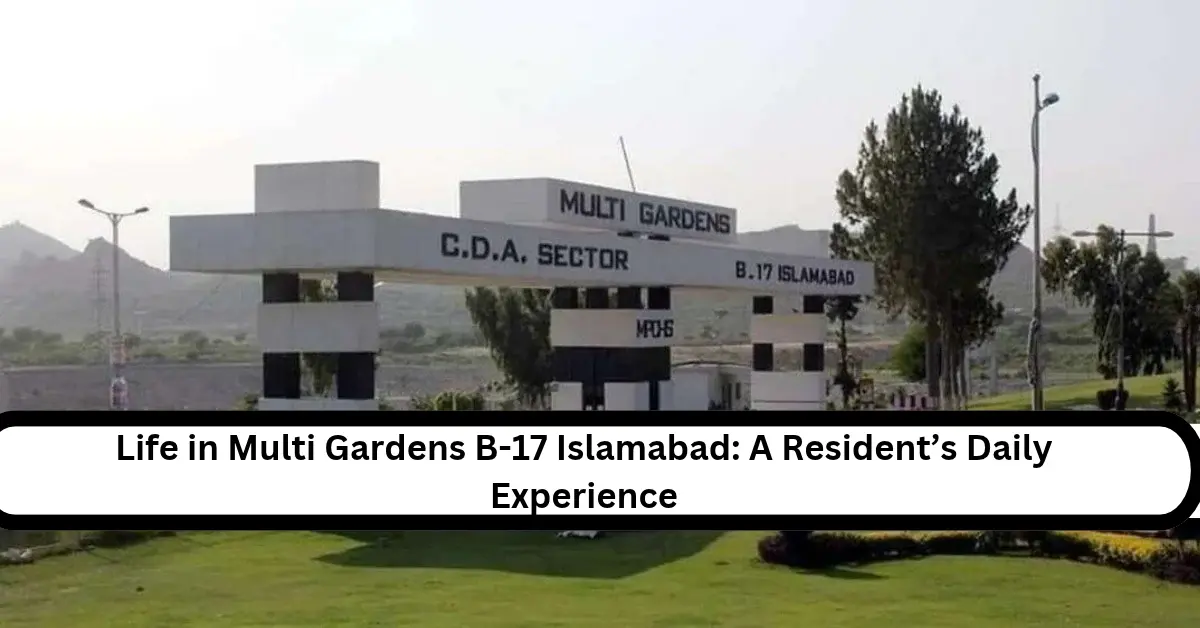
The Multi Gardens Experience in B-17 Islamabad depends on everyday details that can shape your quality of life, from nearby shops and school commutes to reliable utilities and local facilities. Before choosing a home, it is worth checking how well the neighbourhood meets your household’s needs, what daily travel involves, and which services are actually available near your property.
This guide is about exactly that boring stuff, because it’s what the Multi Gardens Experience comes down to. It changes from block to block and sometimes from one lane to the next. We’ll cover everyday convenience, facilities, family needs, transport, running costs, and the checks to make on one specific property before you commit.
A note on honesty. Nobody who worked on this article has lived in your future house, and we won’t pretend otherwise. Where a claim comes from the developer, a property portal, or a news report, we say so. Where nothing reliable exists, we say that too.
Also, B-17 Islamabad isn’t for everyone. Whether it’s for you is the real question.
Understanding the Multi Gardens Experience in B-17 Islamabad
Location, Blocks, and the Immediate Neighbourhood
The society was developed by the Multi Professionals Cooperative Housing Society, or MPCHS. Property portals describe a launch in 2004, a CDA No Objection Certificate for a stated area of land, and two gates on GT Road. A planned link to the M-1 Motorway near Block G also gets mentioned. Every bit of that is reported or market-listed, so check it against CDA records before you build a decision on it.
Distances show why. One listing puts Islamabad International Airport about 5 km away. Another says 6 km, a third says 10 km, and a few write-ups quote thirty minutes by road. They can’t all be measuring from the same gate. The society has Block A through Block G, and the developer’s location page and master plan show how it fits together, with the usual caveat that the developer wrote them.
Why the Exact Property Location Matters
Honestly, calling this B-17 residential area a single neighbourhood is a stretch. It’s several, joined by roads at different stages of completion. Live near a GT Road gate and your mornings look nothing like they would deep inside a block where construction trucks are still a daily fact of life.
So the block name tells you less than you’d hope. Walk to the shop. Walk to the mosque. Drive to the school and to the gate you’d use most. Notice the road surface, whether the streetlights work, and how many plots next door are still empty. A fair picture of any B-17 residential area gets built one street at a time.
A Typical Day in the Multi Gardens Experience
The routine below is made up for illustration, so don’t read it as a real resident’s story. Hold your own schedule against it and see where it breaks.
Morning Routines and Essential Errands
Take breakfast first. It sounds trivial until the only bakery nearby opens at ten and your household leaves at seven. Opening hours decide more than distance does, so find out what they really are.
The drive is the bigger test. Imagine one parent dropping the kids at school and then carrying on to an office across town. What matters is the whole chain, and a road that’s empty at noon can crawl by eight, especially on a school day. Life in B-17 Islamabad will feel easy or exhausting largely because of that single hour.
Midday Responsibilities and Local Convenience
By midday the practical jobs pile up. A plumber has to come, a parcel needs signing for, somebody has to collect a prescription. Coverage here is patchier than most people expect. Some providers serve the whole society while others stop at certain blocks, and a few add a distance charge once you’re far from their base.
Small tests help. Put your address into the delivery app you use and see what happens. Ask a neighbour how long the last plumber took to turn up. Find the nearest pharmacy and time the walk. Nothing fancy, and results vary by block, but it beats guessing.
Evenings, Leisure, and Household Routines
Evenings are dinner, a bit of fresh air, and whatever errands got dropped earlier. Families usually want somewhere safe to walk. A commuter often just wants milk on the way home. Both depend on what stays open after dark, which listings almost never tell you.
Say a household gets home around six and likes eating out twice a week. Knowing that restaurants exist somewhere nearby doesn’t help much. What helps is knowing they’re open at that hour, a short drive away, and fine for everyone at the table, including the child who refuses anything spicy. Spend a full evening in the area before deciding, and see which B-17 restaurants are actually serving.
Multi Gardens Experience: Facilities and Everyday Convenience
Most readers want a tidy list of Multi Gardens B-17 facilities, and lists feel reassuring. They stop being reassuring when nobody has checked them. The developer’s homepage gives its own account of the society, which makes it developer-stated. Use it to collect questions about B-17 amenities, then go and answer them in person.
Grocery Stores, Convenience Shops, and Daily Essentials
Daily essentials seem dull until you’re out of milk at nine at night. Convenience comes down to where the shop sits, what it stocks, when it opens, and whether it delivers to your lane. A big store ten minutes away can easily serve you worse than a modest shop two streets over.
Go at different times, and go on a weekend. See whether the vegetables look fresh or tired. Ask a neighbour which delivery service actually finds the street. Then hold all of it against how your household really shops, because no checklist knows you do the big shop every Saturday.
Parks, Open Spaces, and Outdoor Recreation
Green space is most useful when you can reach it without starting the car. Measure the walk from your door, and look at the path the way a ten-year-old would. Find out who looks after the place too, since a park on a master plan isn’t a park until someone has planted it, lit it, and kept it clean.
Listings from the area mention a zoo nearby and some play areas. The developer’s Multi Zoo guide covers the zoo, and one project listing places a commercial tower opposite it. All of that comes from interested parties, so visit once, check the opening days, and decide whether it fits your weekends.
Utilities, Maintenance, and Basic Services
Utilities shape daily comfort more than any visible amenity. One property listing mentions a dedicated gas supply, and another mentions a water bore with electricity and gas meters. Sellers and landlords wrote those lines, so confirm each service at the property itself. A connection in the next street says nothing about your gate.
Ask to see recent bills, and run the taps to check pressure. Find out how often the power drops in summer. If it rained recently, look at how the street drained. Best of all, find someone already living on the road, because they know how things behave in a bad week and not just on viewing day.
How to Evaluate B-17 Amenities Before Moving
Here’s a filter that helps. Sort every claim into five levels: advertised, existing, operating, accessible, and suitable. Say a gym is advertised, built, and open. It can still be wrong for you because of the fees, the hours, or the distance. Most disappointment comes from skipping a level, and it’s usually the last two.
An inspection settles only part of this. You can see that a facility is open and how far it is from your front door. What you can’t see is how reliable it is over six months. The B-17 amenities worth trusting are the ones you’ve tested yourself and discussed with people who use them.
Restaurants and Food Options in the Multi Gardens Experience
Eating Out and Finding Everyday Meals
We looked for specific, named restaurants inside the society and couldn’t confirm any from a current, reliable source. Making up a list would have been easy and pointless, so this section helps you build your own. Food options fall into three groups: sit-down places, quick takeaway, and the meals you cook from local shopping.
Start a shortlist of B-17 restaurants from current business listings, then add a couple of visits. Note the address and hours, and read recent reviews on more than one site. Star ratings alone can mislead, so look for comments about service and consistency. A place you can’t confirm is open stays off the list.
Restaurant Access, Delivery, and Practical Limitations
A restaurant near a boundary can look close on the map and still take twenty minutes by road. Delivery platforms also draw their own zones, and those often skip outer streets. Two neighbours can end up with very different choices on the same Friday night.
So test it before you fall for any of the B-17 restaurants on your list. Type the address into two or three delivery apps and see which accept it. Compare fees and estimated times, and then try again late in the evening, since many services shrink their coverage at night.
Multi Gardens Experience for Families: Schools and Healthcare
Life in B-17 Islamabad looks different once children are involved, because families carry the longest list of requirements. Think of this section as a way to decide, not a verdict. The developer’s schools, healthcare, and daily living facilities update offers a companion view, though a developer wrote it.
Schools and Children’s Daily Routines
Some sources mention a Federal Directorate of Education NOC for building schools in the society. Read that carefully. It’s permission to build, which is a long way from a working classroom with a free seat for your child.
Ask each school about admission windows, fees, transport, and timetables. Then drive the real journey at school hours. For parents weighing B-17 family living, this one test often settles the question. A school ten minutes away in the evening can easily take thirty at 7:45.
Healthcare Access and Emergency Planning
Healthcare isn’t one service. Clinics handle everyday problems, pharmacies supply medicines, diagnostic centres run tests, and hospitals take serious cases. A hospital’s name tells you nothing about whether the emergency department runs all night or which specialists are on call.
One project listing mentions a medical centre and a hospital a short drive from the commercial area. That’s a market claim, so phone ahead and ask about emergency hours and specialities. Save one nearby option and one bigger option in your phone, and drive to each once. Nobody wants to learn the road during an emergency.
Shopping, Childcare, and Other Household Requirements
Plenty of household needs slip under the radar: domestic help, childcare, laundry, tutoring, repairs. None can be assumed within walking distance, and several depend on whether a person is willing to travel to your block at all.
Write down what your household uses every week and check each item by itself. If a tutor or nanny is part of your routine, ask whether they can reach your street comfortably. Big weekly shoppers should think about storage and carrying too. Small gaps are easy to ignore for a month and hard to ignore for a year.
Is B-17 Suitable for Every Family?
No area suits every household, and this one doesn’t claim to. A family with two working parents and school-age children has different priorities from a retired couple. The first often worries about commute and schooling. The second may care more about quiet and healthcare access.
Good B-17 family living decisions start with honest priorities. List your top five needs and rank them, then test each against something you can verify. If three of your five rest on unconfirmed services, slow down and gather more information before you sign anything.
Commuting, Transport, and Access to Other Areas
Planning a Daily Commute
List the places you visit most: work, school, hospital, relatives, the main shopping area. For each, find the likely route and a backup, and look for bottlenecks, junctions, and roadworks. Listings stress the society’s position between GT Road and the M-1 Motorway. That’s useful, but your own destinations decide what it’s worth to you.
Peak hours change everything. A twenty-minute midday run can double at eight in the morning, and Fridays have their own rhythm around prayer time. Parking matters as well, since a short drive followed by a long hunt for a space is still a long commute. Write down what you find for each route.
Personal Transport Versus Public Transport
Private vehicles give you freedom but add fuel, upkeep, and parking costs. Public transport trims those costs, although coverage can thin out at the edges of a large society. Ride-hailing sits in between, and its availability depends on the block and the hour.
Don’t assume any service reaches every street. Open a ride-hailing app such as Careem or inDrive at your prospective address at different times and watch how long the wait gets. Ask current residents whether they could live without a car. If your household owns only one vehicle, think through how the second adult would get around.
Checking Travel Times Before Choosing a Property
Map apps give estimates, and estimates they remain. Weather, accidents, events, and plain driver behaviour all pull real journeys away from the number on the screen. Treat any displayed time as a rough guide.
The reliable method is to drive it yourself. Pick a weekday, leave at your normal time, and repeat on another day. Compare both runs with the app’s figure and plan around the slower one. Doing this before you sign spares you a daily frustration that’s very hard to undo.
Cost of Living in the Multi Gardens Experience
Housing, Rent, and Property-Related Expenses
Housing costs depend on property type, size, condition, location, and the terms you agree. Two similar homes can rent for different amounts because of road access, finishing quality, or what the owner wants. Listings show asking prices, and an asking price isn’t a signed agreement.
To show the spread, rental listings viewed during research asked roughly PKR 80,000 for a 9 marla lower portion and PKR 120,000 for an 8 marla double-unit house. Those are two data points, not an average, and the listing dates are unclear. Buyers can check the developer’s house prices guide, plots guide, and payment plan page for developer-stated terms. Get current figures in writing.
Utilities, Groceries, Transport, and Education
Recurring costs fall into four groups. Utilities cover electricity, water, gas, internet, and any society maintenance charges. Groceries scale with household size. Transport means fuel, upkeep, or ride-hailing, and education adds tuition, school transport, uniforms, and supplies.
Each group swings widely between households. A stranger’s monthly average won’t reflect your habits, so collect your own numbers. Pull current bills and school fee schedules, and track a week of local grocery prices. A budget built from real documents beats any estimate printed in an article.
Build a Household Budget Before Moving
Start a simple monthly table with fixed and variable costs. Include rent or instalments, utilities, food, transport, education, healthcare, and maintenance. Keep one-time costs separate: security deposits, agent fees, and moving expenses.
Request a current quote for each major item, then add a cushion, because prices and tariffs shift. If the total leaves almost no room, consider another property type or a different block. A realistic budget won’t make the area cheaper. It simply stops the surprises after you’ve moved in.
Advantages and Potential Challenges of Living in B-17
Factors That May Make Daily Life More Convenient
A few things could genuinely help. A property close to a verified shop, a school, and a main road shortens daily trips. Planned blocks with defined layouts can make navigation simpler, and a newer residential area may mean fewer old-building repairs. The Multi Gardens Experience improves most when several of these line up at one address.
Still, these advantages are conditional. They exist only when services are operating and your property sits in the right spot. Tie each benefit to something you’ve verified yourself, and drop any that rests only on promotional language.
Issues Residents Should Investigate
Some factors deserve a hard look: peak-hour traffic, how quickly maintenance responds, service gaps, construction noise, and reliance on a private car. Safety is worth asking about directly too. The developer’s own post on a fire incident in B-17 is a good reminder to ask how emergencies are handled.
Treat these as checkpoints, not proven area-wide problems. Put each one to several current residents, because answers will differ by block and street. Repeated comments deserve more weight than a single opinion, and it’s worth noting where people disagree.
Who May Find the Area Suitable?
Different households weigh different things. Someone working from home may care about quiet and reliable internet. A parent with young children may care about schools and open space. A daily commuter will focus on road connections.
Compare your priorities with the evidence you’ve gathered, and skip rankings against other areas unless you have data for both. If you’re still choosing between property types, the apartments versus plots guide can help. In the end, suitability is personal.
What to Check Before Moving to Multi Gardens B-17
A property-specific check matters more than any general facilities list. Take this one along on every visit to the B-17 residential area:
- Documentation: Ask for ownership papers, society records, and transfer documents, and have a qualified professional review them.
- Utilities: Confirm water, electricity, gas, drainage, and internet at the property.
- Nearby services: Visit the shop, school, clinic, and pharmacy you plan to use.
- Commute test: Drive your main routes at real departure times.
- Maintenance: Find out who handles repairs and society charges.
- Deposits and charges: Get every cost in writing, recurring fees included.
- Residents: Talk to at least two current neighbours.
Treat each of the Multi Gardens B-17 facilities you plan to rely on as a separate item to confirm. The developer’s buying guide explains the purchase process, and its contact page is the place for direct questions.
Final Verdict: Is the Multi Gardens Experience Right for You?
Life in Multi Gardens B-17 will suit households whose daily needs match what the area can actually deliver. The deciding factors are location, facilities, family needs, commute, recurring costs, and the condition of the specific property. Each one varies, so each one needs checking.
That’s why the Multi Gardens Experience is personal rather than universal. Your next step is simple. Visit the exact property, test the commute, talk to residents, and get every cost in writing. If the results match your priorities, you can decide with confidence. If they don’t, you’ve saved yourself a difficult move.
Frequently Asked Questions About Life in B-17 Islamabad
Q1: What is the Multi Gardens Experience like for residents?
Ans: It depends on the block, the street, and the household. Daily comfort follows property location, service availability, and commute. Visit at different times and talk to current residents before forming a view.
Q2: Is Multi Gardens B-17 suitable for family living?
Ans: It may suit some families and not others. Check schools, healthcare, parks, and the commute for your exact property. No general claim replaces a direct look at your own household’s needs.
Q3: What facilities are available in Multi Gardens B-17?
Ans: The developer and several listings name schools, parks, mosques, and shops. Sort each into advertised, operating, and nearby, then confirm opening hours and access for your address.
Q4: Are restaurants and shopping options available in B-17?
Ans: Some options exist in and around the area, but coverage varies. Check current listings, hours, and delivery zones for your address, and visit one evening to see what’s open.
Q5: What should I check before renting or buying a property in B-17?
Ans: Review documents, utilities, nearby services, commute times, maintenance duties, and deposits. Speak with residents. Property-specific checks count for more than general descriptions.
Q6: How can I evaluate the cost of living in B-17 Islamabad?
Ans: Build a monthly budget from current quotes, bills, and school fee schedules. List one-time costs separately. Ignore generic averages that don’t match your household.